Over the weekend I was working on implementing a band pass into the playground example. Originally we were both supposed to work on the beats example but it wouldn’t catch the constant bpm. Which I later found out was because of the direction of where the built in microphone.
I tried to implement a bandpass into the playground idea but it was not so responsive as there would be other frequencies showing such as high frequencies. This idea could not really be built on so we decided to continue working on the beats example. This could be seen as diverging then converging in the design process. Thankfully there wasn’t much time wasted on the idea but it gave us an idea of what we will not pursue. (Update)
Instant – Delay video
My examples were Spotify related where the instant example showed a double-click on a song which played instantly. The delayed example showed a click on the artist’s page where it had a delay to load the page. These design attributes can be helpful to implement within our own work. There was a discussion on if they count if they are intentional or not. Another thing that it was it could be because of hardware of the computer that something has a delayed reaction. Once presented with this task, I was unsure on what I can find that will be based on those design attributes. Although these ideas I had quickly came as we had this time constraint of 10 minutes to look for one idea each one per attribute within the group. That time constraint really helped because I started thinking spotify as they have instant and delayed examples to look at. I thought of a xbox controller as well. These attributes really help conceptualizing an interaction which I think we can keep in mind for our examples. (Updated)
The ball appears when a the sound input reaches 100 BPM. From a design attribute could be seen as targeted interaction. We thought about how to implement natural/accidental sounds so we decided on trying to clap at a 100 BPM and how that experience would be.
By having this more challenging it became a targeted interactions, with an aim which made it a more challenging experience as well as it draws on body movement. It has an action-reaction coupling. We found this to be fairly simple example to try and start working tinkering with the code. We also found out that we won’t look further into the targeted attribute. (Updated)
The balloon moves when the sound input records the BPM on the y-axis where the bottom corresponds to high BPM and top right to low BPM. The experience of this was example was good at visualizing the input but still lacked in fluency. This example could be seen as Step-wise, Precise, and Direct. We knew that for it to become a better experience it had to become more fluent. (Updated)
By making it smoother it became a better experience as it became more fluent of things around it. We started thinking about other dimensions that we can implement and thought the next step was to implement frequency on the x-axis making the visual become more like a graph showing the data. (Updated)
We decided to push this example further with implementing the frequency. High frequency would be the top right corner and low frequency would be bottom right corner. The experience of this was more nuanced as this made the object more lively which in return made it a better interaction.
This example shows us using the piezo contact mic to see if it becomes a more challenging experience which it does since it didn’t catch a lot to what was happening. We then were told it is better to have it on the table although our initial idea was to have a clapping motion we decided it could be not as useful at this stage. Instead we started thinking of implementing the amplitude in our sketch. Ideas such as the image of the ballon becoming bigger.
Below are some things that we experienced as roadblocks or points of exploration:


Clara brought up an idea of how to make one understand the different aspects of the balloon idea, where one would need to use both the frequencies to move side to side and BPM for the speed. While this could be seen as a concept we’ll see what feedback we get on that. I looked into finding a way for when a keyboard note is played that when it’s sustained then the image becomes bigger in size or start moving but that wasn’t possible at the moment to implement since it was difficult to get only one note to be detected when a key is played. It could be seen as limiting but it is important within a design practise to know things that you aren’t able to do.

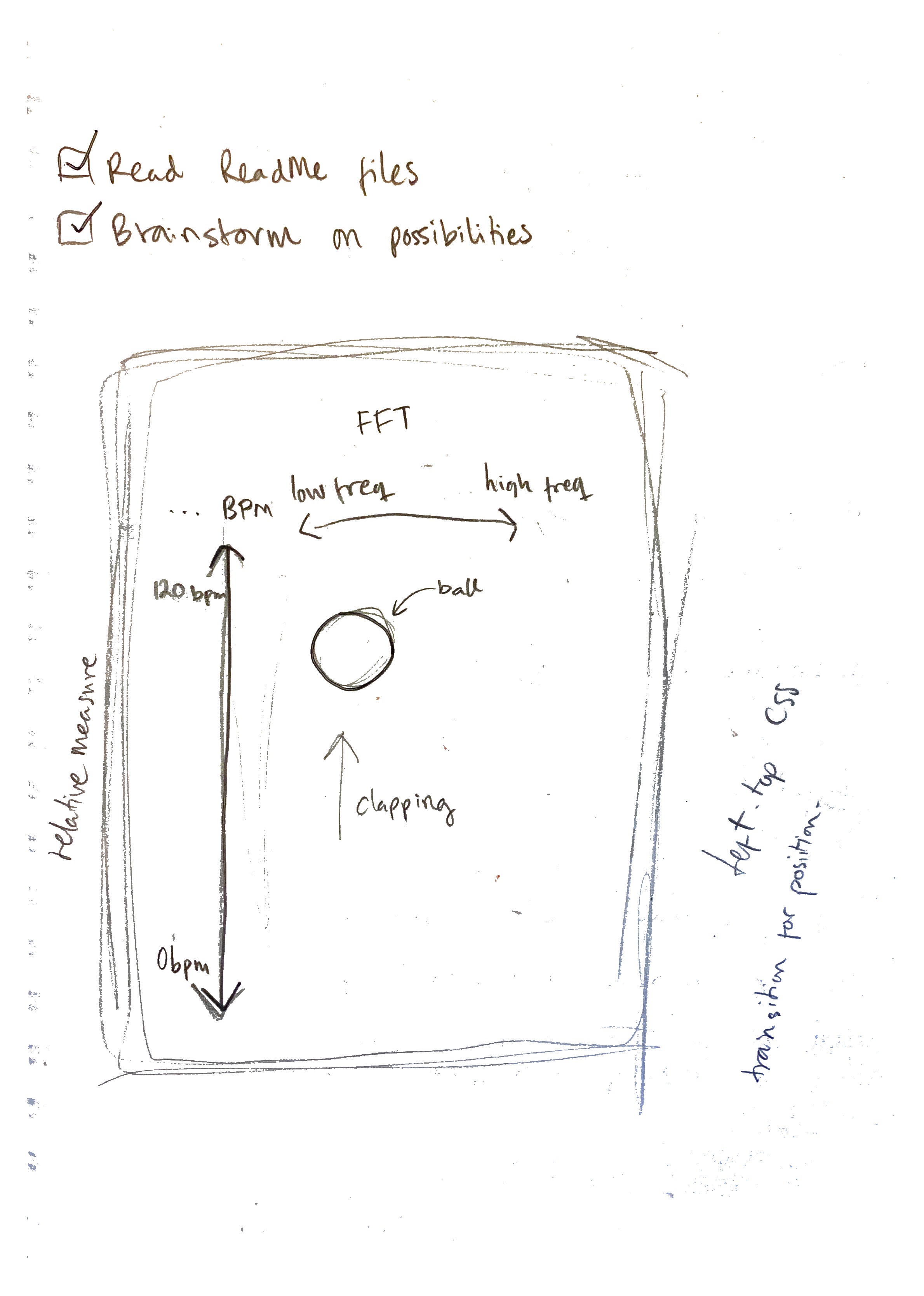

Coaching: We had an idea to have an input and output of sound corresponding to the BPM and through embodiment of how fast one claps the song would go as fast as the BPM. This could be leaning towards a concept and can have many difficulties when discussed with Clint so we decide to continue building on our initial idea.
Aim for monday: For monday we aim to work with the “recent” example and see how we can implement that into our own example to make it more lively and react continuously with the surrounding sound. We also aim to make the object decoupled from the audio input. We would then try to have another object such as water reacting to the sound instead of the balloon which we will work on next week. I also aim to figure out the amplitude as I got it to work but it is not fully functional. I will also look into making the balloon come in from the bottom rather than the top and go from bottom to top as it is more logical with the idea of it being a graph of sorts.
 Abdulrahman's Blog